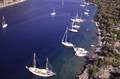
 There
is no better way in which to appreciate Turkey’s infinitely fascinating
history than by water. As devotees of the popular Blue Voyage know, Anatolia,
bridging Asia and Europe, has housed many civilizations, some of which
were in close contact with the sea and thus built their cities on the
Aegean or Mediterranean coasts. Most of those cities have, of course,
fallen. But due to the lack of highways, many of those ancient sites remain
‘undiscovered jewels’ and are thankfully still untouched. Even today,
some of these coastal areas are only attainable from the sea.
There
is no better way in which to appreciate Turkey’s infinitely fascinating
history than by water. As devotees of the popular Blue Voyage know, Anatolia,
bridging Asia and Europe, has housed many civilizations, some of which
were in close contact with the sea and thus built their cities on the
Aegean or Mediterranean coasts. Most of those cities have, of course,
fallen. But due to the lack of highways, many of those ancient sites remain
‘undiscovered jewels’ and are thankfully still untouched. Even today,
some of these coastal areas are only attainable from the sea.
The novelist and short story writer Cevat Sakir Kabaagacli (1886-1973) was sent in exile to Bodrum for a period of three years, in 1925. He enjoyed the simple life he led there and spent most of his time with fisherman, with whom he felt a common love of nature. He also had a deep interest in history and archaeology. Having only the fishing boats as a means of transportation, he started exploring the nearby coasts. When his exile period was over, he chose to stay in Bodrum. Cevat Bey went on to books and articles about his excursions and experiences. Because of his love for Bodrum and the lifestyle he led, he was later called “The fisherman of Halicarnassus” the latter being the ancient name of Bodrum.
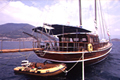 In
the following years he started sharing his experiences with friends he
invited either from Izmir or Istanbul. In all of these voyages, one of
his closest confidants, the writer and an art historian Sabahattin Eyuboglu
(1908-1973), was always present. It was Sabahattin Bey who made these
floating pilgrimages a tradition and named them “Blue Voyages”.
In
the following years he started sharing his experiences with friends he
invited either from Izmir or Istanbul. In all of these voyages, one of
his closest confidants, the writer and an art historian Sabahattin Eyuboglu
(1908-1973), was always present. It was Sabahattin Bey who made these
floating pilgrimages a tradition and named them “Blue Voyages”.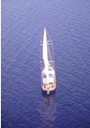 But
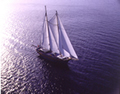
the rustic fishing boats of the earlier Mavi Yolculuk have been replaced
by a new type of boat, a wooden sailing vessel made only either in Bodrum
or Marmaris, called a gulet. Unfortunately, although Blue Voyages are
becoming more and more popular everyday, they risk losing their original
cultural character. A new definition of Blue Voyage seems to be chartering
a yacht and cruising from cove to cove for relaxation and water sports.
But diehards still take the cruise not only to have fun but also to discover
and support the coast’s tremendous historical heritage.
But
the rustic fishing boats of the earlier Mavi Yolculuk have been replaced
by a new type of boat, a wooden sailing vessel made only either in Bodrum
or Marmaris, called a gulet. Unfortunately, although Blue Voyages are
becoming more and more popular everyday, they risk losing their original
cultural character. A new definition of Blue Voyage seems to be chartering
a yacht and cruising from cove to cove for relaxation and water sports.
But diehards still take the cruise not only to have fun but also to discover
and support the coast’s tremendous historical heritage.
For the Blue Voyage, if done properly, should not be just an ordinary leisure trip. While it certain ensures you leave all the worries of the world behind, the blue voyager is also advised to take a hike at least once a day to visit ancient sites. To best achieve your goal, start from Bodrum , Marmaris, Finike, Kemer or Antalya. A recommended 6 night itinerary might start from Finike and continue as follows:
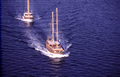 Day 1 After having
met the captain and his crew, ship out to a nearby cove, to Gokkaya Bay
which is an excellent place to spend the first night on board.
Day 1 After having
met the captain and his crew, ship out to a nearby cove, to Gokkaya Bay
which is an excellent place to spend the first night on board.
Day
2 In the morning, cruise to the harbor of Andriake. Go
ashore and drive to the ancient city of Myra which is famous for its rock-cut
Lycian tombs. On the way back drive through the small town of Demre, where
the Church of Saint Nicholas is located. Saint Nicholas about whom little
is known, is the patron saint of children and sailors who was born in
Patara and became the bishop of the Christian church of Myra, in Lycia.
Variations of his name range from Sant Nikolaas to Santa Claus.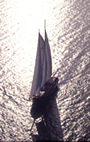
Drive back to the harbor, board the gulet and cruise to Gokkaya Bay to have lunch and take time to swim and relax.
Later in the afternoon, go ashore at Gokkaya for a hike across the Simena Peninsula. This place is only reachable by sea. The trail will lead you to the village of Kale which has been identified as the Lycian town of Simena where there is still a settlement with stone cottages mixed in with Lycian and Roman remains. The castle has a very beautiful panorama; a Lycian sarcophagus standing in the shallows of the harbor of Simena is the most notable ruin. Other remains in the village are a 1st century AD Roman baths complex, a medieval castle with walls that are still standing to their full height, a small theater carved out of rock once seated approximately 300 people, cisterns, and a necropolis with sarcophagi and rock-cut tombs. Anchor somewhere near Simena for the night.
 Day
3 Reach the Sicak Iskelesi and disembark for a hike which
will take you to Aparlea. There is no road that reaches this site. Since
some part of this ancient city extends into the water, this is a good
location to swim and snorkel. It will take some time before the gulet
meets you there, because it takes longer to reach Aparlea from the water.
Day
3 Reach the Sicak Iskelesi and disembark for a hike which
will take you to Aparlea. There is no road that reaches this site. Since
some part of this ancient city extends into the water, this is a good
location to swim and snorkel. It will take some time before the gulet
meets you there, because it takes longer to reach Aparlea from the water.
Continue west from there and pass by the Ulu Burun to reach Kas. Ulu Burun is the place where the oldest known shipwreck on earth was excavated by a team headed by Don Frey.
Dine
in Kas or Kalkan, both lovely resort towns.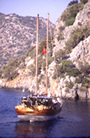
Day 4 The boat starts cruising earlier in the morning while everyone is asleep. It reaches Oludeniz, which is one of the cleanest beaches in the whole Mediterranean Coast. From there drive to the ghost village Kayakoy. Until very recently there was a Greek population living in this village. After the great population exchange it was deserted and today it is a scenic ghost village with the ruins of the churches. Start a hike from Kayakoy; the road is first uphill and later dips down until the Soguksu Cove.
 In the afternoon, cruise to Gemile Island and hike to the top
of the island to visit a Byzantine monastery and some more interesting
church complexes. Spend the night there or continue to Agalimani.
In the afternoon, cruise to Gemile Island and hike to the top
of the island to visit a Byzantine monastery and some more interesting
church complexes. Spend the night there or continue to Agalimani.
Day 5 Start the longest hike of the trip from Agalimani early in the morning. After climbing for about 45 minutes, the ancient city of Lydea will be visible in the middle of nowhere, up on the hill. Continue walking in the pine-shaded trail for about two hours until you reach the sunken baths of Cleopatra. The afternoon is a good time to sail in Fethiye Bay, no matter which way the wind is blowing.
Day
6 Cruise to the mouth of the Dalyan Cayi (River) to take
a small river boat. The Dalyan Cayi is the stream that meanders down to
the sea from Koycegiz Lake a short distance inland. The modern town of
Dalyan is located on the east bank of the Dalyan Cayi and the ancient
Carian city of Caunus lies on the western bank. The beach is a protected
site area for the breeding of Caretta Caretta, the famous loggerhead turtle.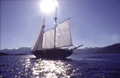
Visit
the ancient city of Caunus. According to Herodotus, the people of Caunus
were the natives of Caria and resisted to the Persians during their conquest
of Caria in the 6th century BC. Four centuries later, the town was sold
to Rhodes by Egyptian generals. Its Hellenistic fortifications still exist,
including a tower and a gateway on the acropolis hill, rock-cut Lycian
tombs, a Hellenistic stoa, a fountain house, a palaestra, a theater, a
Byzantine church and the terrace temple.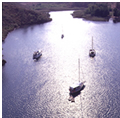
Go back to the mouth of the river, board the gulet and go to the Ekincik Cove to spend the last night on the boat. Next morning is the time to say goodbye to the captain and crew in Marmaris.
 Some
useful information
Some
useful information
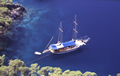
Gulets come in various sizes and accommodate 6-14 passengers. They are
generally made of teak and oak with outdoor and indoor eating areas, comfortable
cushions, and cabins with head and shower. Besides a captain most have
a cook, and a crew whose number depends on the size of boat. To keep the
decks and cushions clean shoes are not allowed on board.
Packing
the trip
Keep your bag light. Take a duffel bag instead of a suitcase. Choose casual
clothing with multiple uses. Take some cotton shirts or T-shirts, wide-brim
sun hat, bathing suits, walking shorts, light wool or fleece sweater,
light rain jacket with hood, hiking boots with ankle supports, walking
shoes, socks and comfortable sandals.
Do not forget to take insect repellent, sunglasses, sunscreen cream, sun-block for lips, a waterproof watch, mask and snorkel, and beach towels. Find toiletries in sample sizes.
Extracted from Serif Yenen's "Turkish
Odyssey". Copyright © Serif
Yenen