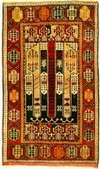
 A
carpet is more a work of art than an article which people step on for everyday
use.
A
carpet is more a work of art than an article which people step on for everyday
use.70% of the tourists coming to Turkey return to their homes with carpets because Turkey is a treasure house of carpets.
To understand how valuable Turkish carpets are, it is better to go back to their origin. For a nomad who lived in a tent, home was a simple place; a combination of walls, roof and floor. The floor was not usually an elaborate structure, just a simple carpet laid directly onto the earth. The carpet was a bug-excluder, soil leveler, temperature controller and comfort provider all in one. The texture of the material beneath one's feet was sensual proof that this was home and not the wild.
As for the history of the carpet, various fragments exist from the 5?6C AD, but it is only from the Seljuk period in Anatolia that many more pieces have survived. Marco Polo, during his journey through Seljuk lands towards the end of the 13C reported that the best and finest carpets were produced in Konya.
 Since
a carpet is more of a work of art, the deeper meanings of each design
cannot be neglected. A carpet can be likened to a poem; neither can tolerate
any extra element, which does not contribute to its wholeness and value.
Therefore, just like in a poem, each pattern of a carpet is chosen for
its beauty and motifs are carefully arranged to form rhymes.
Since
a carpet is more of a work of art, the deeper meanings of each design
cannot be neglected. A carpet can be likened to a poem; neither can tolerate
any extra element, which does not contribute to its wholeness and value.
Therefore, just like in a poem, each pattern of a carpet is chosen for
its beauty and motifs are carefully arranged to form rhymes.
Turkish carpets carry a wide range of symbols. For many centuries, Anatolian women have been expressing their wishes, fears, interests, fidelity and love through the artistic medium of carpets. Even so, there are typical repeated motifs changing from region to region; geometric designs, tree of life, the central medallion design, the prayer niches in prayer rugs, etc.
Turkish carpets are made of silk, wool or cotton. A silk pile gives a carpet the great brilliance. Cotton-warped carpets almost always have a more rigid and mechanical appearance than woolen-warped. Yarns have been used in their natural colors or colored with dyes extracted from flowers, roots and insects.
Carpets are made on vertical looms strung with 3 to 24 warp (vertical) threads per cm (8 to 60 per inch) of width. Working from bottom to top, the carpet maker either weaves the rug with a flat surface or knots it for a pile texture. Pile rugs use 5?7.5 cm / 2?3 inches lengths of yarn tied in Turkish (Gordes) or Persian (Sehna) knots with rows of horizontal weft yarn laced over and under the vertical warp threads for strength. After the carpet is completely knotted, its pile is sheared and the warp threads at each end are tied into a fringe. The finer the yarn and the closer the warp threads are strung together, the denser the weave and, usually, the finer the quality.
The best-known
flat-woven rug is the kilim, which is lighter in weight and less bulky
than pile rugs. It has a plain weave made by shooting the weft yarn over
and under the warp threads in one row, then alternating the weft in the
next row. The sumak type is woven in a herringbone pattern by wrapping
a continuous weft around pairs of warp threads.