 Marmaris

Our town was once a small fishing port visited
by the occasional traveller who realised then that this was an utopia
. Many fell in love with the beauty and nature of this region and stayed
. Today Marmaris is an atttactively organised tourist resort, visited
by friends from worldwide destinations who return and again .

Icmeler
This picturesque resort lies 10 kilometres from Marmaris
at the western end of the bay and is well known for its famous springs
whose waters have proved to be benecificaial to the digestive system .
The noted beach stretches along the length of the bay is bordered by a
varety of restaurants , bars and hotels strung along the promeande . ��meler
offers a wide selections of top quality hotels, family hotels, pensions
and apart motels to suit everyone's standart and prefences, whilst the
older residential area nestles under the hills at the rear of town.
Dalyan
A long flat sandy beach with a shallow river floowing beneath
the cliffs. The trip into the delta starts as the litlle boat buumps the
sea bed as yyou cross the river bar to meander in the estuary with sand
dunes as far as eye can see. this beach is the secand largest loggerhead
and Mediterranean Green turtle breeding ground in the world and is strictly
under conservation . The beach is out of bounds after dark to project
the females when laying their eggs in the sand and later when the young
hatch to make their way to the sea following the light of thee moon.
Turunc
This picturesque village surrounded by high mountains with
its sandy beaches lies just outside Marmaris bay. There are pensions and
hotels of all categories with small open restaurants on the seafront.
A regular boat taxi service runs to and from Marmaris, or take the scenic
mountain road .
Armutalan
Situated under the pined laden slopes of Marmaris with
average distance to the beach being 600 meters, rests the area of Armutalan
. Holding a very important role in producing a higly concertrated bedding
capacity for the incoming tourists . With a high number of selg-catering
units and complexex, Armutalan is preferred mainly by children related
families .
All sorts of dining is also avaible, especialy the authentical Turkish
variety together with local entertainment centers . Plus enough shopping
choices to fulfill almost anyone needs. The local "Dolmu�" route
runnig through here makes transportation as simple as can be with only
a 5 minutes ride to the town centre .
Kavaklidere
An hour north of Mugla this town is known for its copper
smelting and craftsmen. In this village, which is untouched by tourist
development, you ccan watch the workmen in the smeltering sheds and move
on to see the copper beign beaten into the artistic forms of bowls, jugs
and vases.
Datca
Datca, 79 km from Marmaris is a pleasant sleepy little
town, which was in ancient times the Capital of the area. After leaving
Marmaris town the road climbs steeply through dramatic mountain scenery
and the aromas of thyme, rosemary and sage. Travel along the very top
of the Datca peninsula flanked by turquoise coves on both sides, a slice
of green creating a natural division where the Aegean Sea and the Mediterranean
Sea meet. Walkalong Datca beach to the Sultan's pool, where legend has
it that the fresh spa water bubbling up from beneath made their wives
even more beautiful . Well it's worth a try!
Knidos
Continuealong the Datca peninsula to ancient Knidos, one
of the six cities of the Dorian Confederacy. The solitary ruins of Knidos
are scattered on the hillside overlooking the ancient harbour. Much of
this large site has stil to be excavated but the skeleton of the city
can easily be seen. In its time famous for its statue of Aphrodite created
by the Greek Sculptor Praxiteles.
In the 4th century BC this was one of the first statues of a naked woman
and as such attacted many early tourists.
During the same period, Eudoxos, one of the founding fathers of Greek
geomery, lived in Knidos and set up an observatory to study the stars.
Ephesus
It can be said that Ephesus is one of the most beautiful
ancient cities in the world. In ancient times its favorable location at
the mouth of the Cayster River made it the foremost commercial city of
a coastal region that also included the cities of Miletus, Smyrna and
Pergamum, but the silting 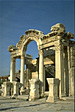 up
of its harbor gradually resulted in the loss of this preeminence. The
city has been excavated for more than one hundred years; the extensive
remains are predominantly from the later Roman period.
up
of its harbor gradually resulted in the loss of this preeminence. The
city has been excavated for more than one hundred years; the extensive
remains are predominantly from the later Roman period.
Ephesus formed a focal point in the ancient world because of its protected
harbor and as a starting point for the Royal Road via Sardis to Susa.
It was also a cult center attracting thousands of pilgrims for traditional
worship of the female, first Cybele, then Artemis and finally the Virgin
Mary. Ephesus was also home for the early philosopher Heraclitus.
Bodrum
(Halicarnassus)
Founded possibly in the 11C BC, Halicarnassus came under
Persian domination c.540 BC. The Persians ruled through native tyrants,
one of whom, Artemisia, shared in the Persian defeat at Salamis (480).
Later in the Persian Wars Halicarnassus joined the Delian League. The
city enjoyed its greatest prosperity under Mausolus, a Persian satrap
who achieved virtual independence in the 4C BC. The temple erected in
his honor, the Mausoleum, became one of the Seven Wonders of the World.
Captured by Alexander the Great in 334 BC, Halicarnassus soon declined.
Early in the 15C AD the Knights of Rhodes built a picturesque castle dedicated
to St. Peter. Its walls were built largely of material derived from the
ruins of the classical city. Remains of the Mausoleum, excavated in the
1850s, are in the British Museum in London.
Halicarnassus was also the hometown of the famous ancient historian Herodotus.
Fethiye
(Telmessus)
Fethiye has become popular for beach holidays and yacht
cruises. The modern town of Fethiye covers the site of ancient Telmessus.
History of Telmessus Although it was not then a Lycian city, Telmessus
was first mentioned in the tribute lists of the Delian League in the 5C
BC. It became Lycian in the 4C BC only after the siege of the city by
Pericles, King of Limyra. Later, it was taken by one of the governors
of Alexander the Great with a trick similar to the Trojan Horse. An orchestra
consisting of women passed the guards and occupied the acropolis.
Telmessus became part of the Roman province of Asia in 133 BC. During
the Byzantine period Telmessus was known as Anastasiopolis. Rum population
lived in the area until 1922.
The Site
The hill behind Fethiye is encircled by a strong wall which is the only
remain of a medieval castle.
More than 20 Lycian rock tombs in the steep rock wall above the town are
the rare surviving remains of the ancient times. Among these tombs the
most prominent is the one which belongs to Amyntas. It dates from the
4C BC and is in the form of an Ionic temple with two Ionic columns. Most
of the tombs are of the house-types imitating the Lycian wooden houses
in their plans.
 Olu
Deniz (Dead Sea)
Olu
Deniz (Dead Sea)
Dead is in the sense of calm. It is a sheltered lagoon of great beauty,
almost totally cut off from the sea, at the northern end of a long cove.
Stretching from the lagoon to thesouthern end of the cove is a long, sandy
public beach.
 Pamukkale
(Hierapolis)
Pamukkale
(Hierapolis)
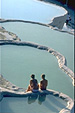
Pamukkale has always been a very popular settlement where
the hot springs were believed to have healing powers, so the city became
the center of a pagan cult in antiquity and a spa resort today.
The city was on the borders of Caria, Lycia and Phrygia and had a mixed
population. Citizens were usually involved in the wool industry and little
has changed as it is still a textile center.
The
Natural Aspect
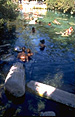 The terraces
were formed by running warm spring water, at a temperature of 35 �C /
102 �F containing calcium bicarbonate. When the water loses its carbon
dioxide it leaves limestone deposits. These are of different colors and
shapes in the form of terraces with pools, overhanging surfaces and fascinating
stalactite formations. Pamukkale which means "cotton castle"
in Turkish takes its name from these formations. According to scientists,
if the water had always flowed at this rate, the terraces must have begun
forming 14,000 years ago.
The terraces
were formed by running warm spring water, at a temperature of 35 �C /
102 �F containing calcium bicarbonate. When the water loses its carbon
dioxide it leaves limestone deposits. These are of different colors and
shapes in the form of terraces with pools, overhanging surfaces and fascinating
stalactite formations. Pamukkale which means "cotton castle"
in Turkish takes its name from these formations. According to scientists,
if the water had always flowed at this rate, the terraces must have begun
forming 14,000 years ago.
A little further away from Pamukkale, near Karahayit village is another
thermal spring, Kirmizi Su (the Red Water) with warmer water but less
carbon dioxide gas where the running water creates a reddish effect different
than the white cotton terraces of Pamukkale.
 Geyre
(Aphrodisias)
Geyre
(Aphrodisias)
"Imagine coming upon a city of antiquity so rich in
archeological treasure that choice sculptures roll off the sides of ditches,
tumble from old walls, and lie jam-packed amid colonnaded ruins."
Those are the words of Turkish archeologist Professor Kenan Erim who directed
the excavations at Aphrodisias under the auspices of the New York University.
He is so closely associated with the site that he can suitably be accepted
as the father of Aphrodisias and therefore fully deserved to be buried
near the Tetrapylon.
The name of the city has the same root as "aphrodisiac". Both
words derive from the Greek name for the goddess of love, Aphrodite. Aphrodisias
was one of several ancient cities dedicated to the goddess of love. Within
the borders of Caria, during the Roman period, Aphrodisias became an artistic
center with a famous school of sculpture.
The site has been systematically excavated since 1961 by professor Kenan
Erim and has yielded a wealth of art treasures to archaeologists.
Names of many sculptors from Aphrodisias have been seen in lots of works
in Italy, Greece and elsewhere. Fame of Aphrodisias is not only limited
to arts. It also had a number of renowned scholars and writers as well
as philosophers, of whom the most notable was Xenocrates.
School of Sculpture
Statues were carved from the local white, grayish blue
Carian marble, mostly from Babadag (Salbakos), 2,308 m / 7,572 ft high
nearby mountain. Sculptors from other areas came to Aphrodisias for annual
sculpture competitions. The eyes of the statues found here are full of
expression and vitality and the bodies seem capable of moving. The public
monuments in Aphrodisias were decorated with "peopled scrolls"
which were one of the characteristics of stone carving produced by the
school of sculpture in Aphrodisias.
History of Aphrodisias
Excavations in the 24-meter-high (78 ft) theater hill have
revealed layers of settlement going back to the Bronze Age (c. 2800-2200
BC).
It was founded in the 5C BC and flourished under the Roman Empire (1C
BC-5C AD). Mark Antony recognized the autonomy of Aphrodisias in the 1C
BC. In the Byzantine period it was first the seat of an archbishopric,
then of the metropolitan of Caria. In the 6C AD the name of Aphrodisias
was changed to Stavropolis, the city of the Cross, to erase the pagan
goddess of love from people�s minds. As the capital of Caria Aphrodisias
was finally called Caria which then became Geyre in Turkish. Later in
the 13C it was abandoned.
Kumlubuk
6
kilometres from Turunc lies Kumlubuk on a beatiful wide sweep of beach.
En-route the road passes the ruins of Amos, high above the sea so clear
that fish at a depth of 5 metres still be seen. The resort, which is best
reached by boat has open restaurants and modern touristic facilities.
Ciftlik
Accessible by road from icmeler, fhis village is famous
for its clean, sandy beach and little restaurants. For those wanting modern
comforts there is a 4 stars tourist accomodation centre. The road is safe
but presently of jeep safari style, so you may prefer to enjoy the 2 hours
sail from Marmaris, returning to your hotel on same boat in the evening.
Hisaronu Bay
Take the Datca road from Marmaris, Climb through rugged
scenery and then leave the highway for a narrow mountain road to gulf.
An area favoured with sweet scented pines and carpets of wild flowers.
See hundreds of blue painted bee hives with their busy inhabitants making
honey for which this area is famous. Swim on any one of the many secluded
beaches.
The road leads you down to the village of Orhaniye in a tranquil setting
at the very head of the Gulf. Across the bay from Orhaniye is a tiny island
capped by an ancient fortress. Lunch at a restaurant where the visiting
yatchs are moored. In the afternoon followthe dirt road to bozburun, a
village renowned for the contruction of 'gulet', the traditional wide
beamed, wooden boats to be seen all along the coast. Here, there are some
charming trestaurants and specialist boutiques.
Gokova Gulf
The enormous sweep of G�kova Bay on the road to Marmaris
is a patchwork of endless plains and citrus plantations streching out
to meet the sea. Impressive pine forested mountains create a dramatic
backdrop to this conservation area where you will often see small green
terrapins and speckled brown trout swimming in the clear streams.
Akyaka
Akyaka is village on the shores of G�kova Bay. 30 - minutes
drive from Marmaris, its fish restaurants on the river have been a stopping
place for Turkish travellers for many years. The surrounding mountains
and countryside have been declared a conservation area, and the plains
beetween the two rivers are 'A' class sanctuary . The reed beds are home
to many rare birds, offer colonies and many other species of wildlife.
Local building codes ensure that all new constructions are designed on
the same lines as the houses of 200 years ago. Angled rooms and the use
of local pine make this architecture most interesting. The ruins of the
city of ldyma's and 5km along the bay is the tiny beach of Cinar.
Camel Wrestling
If your holiday coincides with the Camel Wrestling season
during the winter months, do not be alarmed. Camel Wrestling is strictly
a spectator sport No-one gets hurt and that includes the camels. A Turkish
wrestling camel is a cross between an Arabian riding camel and a Bacran
Turkish camel. He is all male and he only has one hump. He is called a
"Tulu".
Meryemana (The Virgin Mary�s House)
It is known with certainty that the Virgin Mary went to Ephesus and lived
there for some time. Whether or not she died in Ephesus was not known
until Anne Catherine Emmerich�s vision. The stigmatized German nun who
had never been to Ephesus had a vision of the House of the Virgin Mary
and described it in detail to the German writer Clemens Brentano who later
published a book about it. Catherine Emmerich died in 1884. In 1891 Paul,
Superior of the Lazarists from Izmir read about her vision and found a
little building which corresponded with Emmerich�s descriptions. Archeological
evidence showed that the little house was from the 6C AD but that the
foundations were from the 1C AD.
This place was officially declared a shrine of the Roman Catholic Church
in 1896, and since then it has become a popular place of pilgrimage. Pope
Paul VI visited the shrine in 1967.
Miletus
Miletus, an ancient city located near the present Akkoy at the mouth of
the Buyuk Menderes (Meander) River, owed its importance to its position
on trade routes. It was one of the largest cities in Anatolia with a population
of between 80,000 and 100,000. Highly prosperous, it founded many colonies
and was the home of the 6C BC philosophers Anaximander, Anaximenes, and
Thales, the town planner Hippodamus and architect Isidorus. Miletus seems
to have produced geniuses the way Aphrodisias produced sculptors.
Didyma
The word Didyma meant "twins" and was associated by some as
being the meeting place of Zeus and Leto to have their twins Apollo and
Artemis.
Didyma was famed as a prophecy center dedicated to Apollo which served
a similar purpose as the Delphi of Anatolia. It was not a city but a sanctuary
linked to Miletus by Milesians with a 19 km / 12 mi sacred road. However,
this road may not have been constructed until the end of the 1C AD. In
addition to pilgrimages made by sea, some festivals of drama, music and
sports were held there every four years.
Basilica
of St. John 
At his crucifixion Jesus asked his beloved disciple, John, to look after
his mother. John and the Virgin went to Ephesus between 42 and 48 AD and
lived there. John was martyred under the rule of the Emperor Trajan. There
has been much discussion as to whether John the Apostle is confused with
St. John the Theologian whose name, Hagia Theologos,gave the Turkish name
first for the town and later only for the hill, Ayasuluk. A small church
on the Ayasuluk Hill was dedicated to him in the 2C AD. This church was
replaced in the 6C by a huge basilica built by the Emperor Justinian,
the impressive ruins of which are still visible.
The basilica had a cruciform plan with four domes along its longitudinal
axis and a pair flanking the central dome to form the arm of the cross.
Under the central dome was thesacred grave of St. John. Pilgrims have
believed that a fine dust from his grave has magical and curative powers.
In the apse of the central nave, beyond the transept is the synthronon,
semicircular rows of seats for the clergy. To the north transept was attached
the treasury which was later converted into a chapel. The baptistery is
from an earlier period and now located to the north of the nave.